Showing posts with label running. Show all posts

Wednesday, January 31, 2018

Baby, It's Cold Outside

I haven't posted anything here in over 13 months. Sigh. Just busy with the ordinary to be honest - and not really running all that much, unfortunately.

Is it a "running life" when I can manage only 50 miles per month, and even that minor mileage makes my legs hurt?

Of course, living in Minnesota makes running an interesting challenge, due to the full spectrum of seasons we experience here. People I talk to are often aware of the fact that it can be nearly 40 below zero Fahrenheit in the winter here, but suspicious of me for lying when I say it can also hit 100 F in the summer. One nickname for it is "shake and bake" -we shiver in January, and broil in July.
As you can see, the average low in January is in single digits, and the average high in July is in the 80s. of course, the record low and record high surpass those averages.
Source: http://www.intellicast.com/local/history.aspx?location=USMN0503
This time of year, it's shivering season! Speaking of shiver, here's a post-run photo of me a couple of weeks ago - January 13, 2018.
No, it wasn't snowing, that's just condensation from breathing when the ambient temperature is 11 degrees below zero Fahrenheit.

Someone viewing this asked me what I wore on my feet in that kind of weather. My answer: shoes.

I wasn't trying to be funny, and maybe it's just me who can do this, but I wear exactly the same socks and shoes whether it's 100F or -30F. And in all temperatures in between. And my feet sweat, throughout that range!

If it's cold and windy, I will admit that my standard nylon mesh uppers on my running shoes allow that cold air to creep in during the first 3 or 4 minutes of my run, and my toes feel a little chilly. But once I'm trucking along, I don't notice it anymore. And when I finish the run, my shoes look a lot like the face mask in this picture: frosty.

Comparatively, I have a lot more trouble keeping my hands warm. What I've learned over the years is that the best approach for me is a base layer glove of moisture-wicking material (thin polypropylene), over which I pull a simple nylon shell mitten. With that combination, my hands will actually sweat during the run, and when I pull of the mitten, that same condensation-turned-to-frost will tumble out.

Some people think I'm crazy for running in such cold weather. But the thing is, I have friends who regularly run in even colder climates! As long as I'm layered properly, and visible, it's fine. By visible, the main point is that I generally run in the early morning hours, and here in Minnesota it's as dark as night. I wear a headlamp, which also has a blinking red light affixed to the back of the head strap, and I wear reflective gear including a lightweight reflective vest. At that early hour, car drivers are simply not thinking about a runner - they are just commuting to work (generally) and in a hurry. I need to be seen, so I need to light up in the dark.

One last tip: I slather petroleum jelly on that little bit of exposed skin near my eyes. It helps prevent frostbite, and also helps keep my eye lashes from freezing together when I blink. I kid you not. It's happened to me, and it's such a strange sensation - you can't open your eyes! I've had to stop, pull off my gloves, and rub my eyes back open. However, when my lashes are greased up, it never happens. Fore-warned is fore-armed, as they say.

Safe running my friends!

Thursday, November 17, 2016

So What is a Runner Anyway?

When I first paid attention to Running (with a capital R), it resonated with me because it felt like an attainable goal. You see, I was a scrawny, nerdy kid. Good student in school, but rarely picked in the first or even second wave of teammates during gym class. I *liked* sports, I was after all a rather avid watcher of the NBA and the NFL even before my age hit double digits, and the spectacle of the 1968 and 1972 Olympics impressed me deeply (I was six and ten years old respectively).


Frank Shorter won the 1972 Olympic Marathon (image source:http://bit.ly/1pIAFd9
I also had a competitive streak - I'd accept most any challenge to a contest with other kids. Race you around the block? Let's see who can jump their bike the farthest off of that broken sidewalk? Race you across the pool! Dodgeball! But the truth is that I wasn't so great at most of the sports and games that everyone played. And no amount of passion nor practice time was going to transform me from a 95 pound Freshman weakling into a starting varsity linebacker.

In running, I happened upon an endeavor in which the amount of time and effort you put into it was nearly exactly matched by measurable improvements. With running - especially on the track - there is an actual, objective way to know if you've gotten better: elapsed time for a specific distance. Hmm.

I wasn't so good in the beginning. In my first race ever - I was a 7th grader - I finished dead last in an 880 yard race on a dry and dusty cinder track. I don't have any record of that event, but I think there were nearly 30 of us on that track that afternoon. I can still recall vividly several memories of that event - most involve seeing other boys just running away from me no matter how hard I pushed myself, and I can almost feel the dry-throated burn of breathing the dust they kicked up in front of me. I was pretty embarrassed, but somewhere down inside (and maybe this is just my innate character) I felt a kind of glowing ember of determination to get better. Each day that I strained a little harder, it paid off - slowly of course, these transitions don't take place overnight.

In fact, I think I can trace the actual transformation to Runner as happening during the spring of 1978, my sophomore year running track in High School. I had pushed myself long enough and hard enough to be able to be a factor in a race. I didn't win anything, mind you, but I was *in* the mix.

Over the next 10 years or so I would strive to reach higher and higher levels of running success. My race performances got faster, my race placing higher. I won my first race as a Senior in High School - what a feeling! I went on to run over 700 races, and spent better part of 3 decades as a self-identified Runner.

Regrettably, in my youthful arrogance I once proclaimed, "If I ever can't run a sub-6 minute mile, I'll quit the sport. I'll never be a JOGGER!"

Well, folks, I'm pretty certain that I'll never run a sub-6 minute mile again. In fact, I'll likely never run a sub-7 minute mile. These days, in my mid-50s with a variety of ailments and mechanical flaws, it's all I can do to get out a few times per week for a few miles each, usually around 8:15-8:30 per mile pace.

Am I still a runner?
Image Source: http://izquotes.com/quotes-pictures/quote-the-difference-between-a-jogger-and-a-runner-is-an-entry-blank-george-sheehan-300124.jpg
I guess George Sheehan would have said no. I don't participate in races anymore. I rarely buy new running shoes. I rarely hang out with Runners.

But I still LOVE the feeling of trotting along on my own two feet, in every kind of weather. A friend recently posted something on social media, referring to people who responded to his running day-after-day with "What do you do when it rains?". His response, "I get wet". Perfect.

Being a runner, or being anything really, as defined ONLY by external sources is a risk to one's own sense of identity. Don't ever let others decide who you really are.

Here's my bottom line: I'm old, I'm slow, I don't race, I don't run every day, and sometimes even a little bit of jogging really hurts ... but I still FEEL like a Runner. We are allowed to decide for ourselves what category we inhabit. From a few decades of experience, and plenty of eating crow, I now confidently feel that I am a Runner, and I am also a Jogger and a Walker and a Cyclist and sometimes even a really clumsy Swimmer.

Monday, August 31, 2015

The Five Phases of Cycling (at least for me)

A recent email exchange with a new connection got me to thinking about the place of cycling in my life. 

Of course, I am a runner, I see myself as a runner, it’s even tied up in my sense of identity. Running has been and most-likely will always be my favorite way to engage with myself and with the world around me. I prefer to run outdoors, if possible on narrow trails in the deep woods, floating along, fully alive. There was once a time when I would run every day, year-round. Now, as I get older and parts of the old machine are wearing out, I just can’t run all of the time. Heck, lately I’m not even running at all! Sigh. But I have been doing a bit of cycling, in fact lately it's nearly every day. Admittedly, cycling will never live up to running in my heart-of-hearts, but it’s still pretty good in my humble opinion. It gets me outside, gets my heart and lungs and muscles working, and lets me cover some ground in the process.

When I reflect back on the place that cycling has had in my life, I think there have been five distinct phases.

1
As a kid, I initially struggled with getting going on a two-wheeler. My father tried and tried, but I think the combination of too many instructions and the clear disappointment he seemed to have in my repeated failures just made matters worse. Then, one day in the middle of winter - I think I was six years old - right at sundown and with no one looking, I dragged my bike out of the garage on its half-inflated tires, jumped on, and road away! It felt like some kind of miracle, but I'm sure it was just a bit of physical development and probably those soft tires that helped make it happen. By spring, I was riding all over my small town of Baraboo, Wisconsin. So for me cycling started with failure, but built up to mastery - which led to freedom, the sensation of speed, and even daredevil jumps! We built a crude ramp out of plywood and "soared" over our lined-up Matchbox cars, like miniature Evel Knievels. In fact, I pushed it so hard that I ended up breaking the welds on the frame of my metallic orange Huffy single speed with the silver banana seat!
I wish I had a photo of my old Huffy - it was something like this, though mine only had coaster brakes.
2
During college, cycling was transportation, and I biked everywhere on my trusty yellow Schwinn Continental. But I was a runner, so I never considered it training and never logged any of it. But I'd wager I was at times doing close to 100 miles a week, it probably helped augment my running success. I never even considered bike racing, I didn't know much about it and I was already entirely focused on running.
Image Source: http://oldtenspeedgallery.com/blog/wp-content/bikes/2012/06/mike-1972-schwinn-continental-00.jpg
3
On and off, from the late-1980s through the early 2000s, I rode and even sometimes raced on mountain bikes off-road. I wasn't all that successful, partly because (again) I didn't make it any kind of focus - it was just fun. Visiting my best friend in Sonoma County, California was always great fun, we'd ride on Mount Tam or in Annadel Park, the very places where off-road cycling was born. For me, mountain biking was a total blast but admittedly almost always involved crashing and bleeding - not such a good idea now for someone my age and with the blood thinners I take!
Image Source: http://www.xo-1.org/2011/01/1982-ritchey-mountainbikes-catalogue.html
4
In the mid-1990s, I developed a pretty severe hamstring injury from running, a partial tear that was just not healing. I took up cycling again because pedaling just didn't seem to hit that muscle the same way, so I could ride and ride with very little pain. By putting in the miles and (for the first time) basically concentrating on cycling, I quickly got better at it despite being in my mid-30s already. Eventually, I caught the racing bug. My first Cat 5 race (What's a "Cat" in bike racing?) was an easy victory, I rode off the front of the pack in a CRCA race in Central Park and won by a couple of minutes. I then raced one year at Cat 4 and earned the points to move up to Cat 3. Unfortunately, I was taken out in a crash caused by a poor bike handler during a road race in the Tour of Texas in 1996. No broken bones but a very severe concussion that led to short term memory impairment and light sensitivity - not to mention road rash all over my body. Ow. Big ow. When I finally felt better - thank goodness - I went back to running - it just seemed safer!

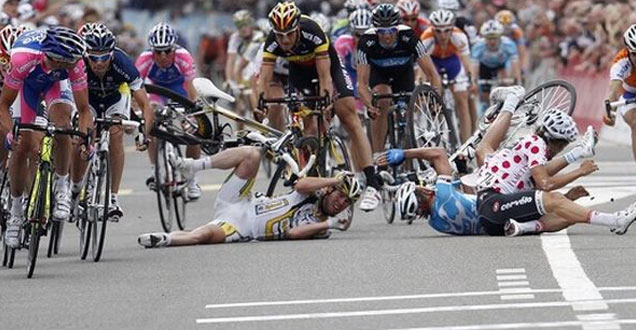
Image result for bike race crash
Ow! Ow! Ow! Of course, this photo is not of my crash - those guys are pros.
I am definitely NOT a pro by any stretch of the imagination.
Source: https://bit.ly/2FhFsyt
5
Now, in my 50s and post-heart attack, I'm using cycling mainly for fresh air and fitness, and because I just can't run much without getting injured or incredibly sore. I haven't raced a bike in many years, but I'm somewhat intrigued by the gravel race concept - I suppose it's much less technical than mountain biking, so for a klutz like me there should be fewer crashing and entirely less bleeding! I don't currently own the kind of bike to race in gravel, but I've been told that gravel racing is truly grass roots, welcoming, and low-key. Something to consider, if that old racing bug bites me again.
How I feel, most days.
Image Source: https://maddogmedia.files.wordpress.com/2011/12/fatguysuffers.jpg
When it comes to cycling, your experience may be similar to mine, or very different, but I think we can all agree that anything that gets us off the couch and out into the world is ultimately a good thing. Whether you are a hard-core cyclist, a recreational rider, or a total beginner, I hope that your rides are safe and fun and leave you happily fit.

If you're of that ilk, you can follow me on Strava (a cycling app that tracks rides and allows cyclists to compare themselves to others).

Thursday, June 25, 2015

Recovery at One Year: A Part-time Runner

It's been one year since I found myself in an ambulance, speeding down the interstate, on the way to St. Cloud Hospital for emergency life-saving surgery due to a heart attack.

One year.
Image source: http://soundreason.org/wp-content/uploads/2014/07/1-year-12-months2.jpg
That year has been spent well, I think. I've followed doctors' orders, I've made tweaks to my diet (really eliminating saturated fats and especially animal fats), stayed consistent with exercise, and tried hard to adapt to my cocktail of medications.

Overall, I'm just damn glad to be around to complain about all of the above!

One of the bigger changes in my life I suppose is that I'm really just a part-time runner now. I spent so many years - decades actually - running nearly every day. I was never quite able to be one of those so-called "streakers" (people who literally run every single day for years and years), usually due to some illness or injury or more-important life event. I did once have a streak of 1805 consecutive days running (that's 4 years, 11 months and 9 days - for those who are counting). That streak came to a stop because of a bad case of the flu that put me in bed for a few days. During that streak, I ran 15,372 miles for an average of 8.5 miles per day. Seems impossible to me now! Last thing about that streak: it was a rather long time ago, ending in 1986, the last year (I think, but correct me if I'm wrong) that gas prices in the US dipped below $1 per gallon. Ah, yes, 1986.


Fast forward to today: By part-time runner, I mean that I'm able to run a bit, but just not every day - and not by a long shot. I get too sore, I get too tired. Typically, I can get out 2 or 3 times in any given week. I am able to go 6-8 miles each time, so I'm not a non-runner by that measure. My other days are focused on cycling or sweating it out on the elliptical. I have been able to exercise almost every day so far in 2015, hopefully that will continue.

But I confess that I do miss running every day. It had a kind of consistent rhythm that grounded me in so many ways. Somehow alternative exercises just don't quite hit the same notes for me, psychologically.

But you know what? I'll take it!

At least I can still get out there and put in a few miles. And deep in my heart I'm not giving up just yet. Perhaps modern medicine will find ways to keep my cardiac issues at bay and allow me to slowly rebuild without all of the side effects holding me back. Time will tell. Hey, maybe arterial plaque-eating nanobots!
Image source: http://i.ytimg.com/vi/f3cKZ4YVXQg/hqdefault.jpg
Lesson: Never take for granted your days of running. Revel in the feeling, appreciate the opportunity you have to be completely alive and testing yourself physically in such a natural way. Every run is a kind of mini-miracle, try not to forget that.

Wednesday, February 4, 2015

Reality, Nostalgia, the Space Between, and the Wisdom of Sheehan

(not me) Image source: http://blog.run.com/blog/training/how-to-run-in-the-snow/

Reality:
  • old
  • slow
  • heart attack survivor
  • plodding along this morning
  • in the fluffy snow
  • at 12 degrees F
  • huffing and puffing to maintain 8:30 per mile pace
  • keeping heart rate under 130 bpm
  • BUT ... wearing probably the nicest high-performance, all-weather gear I've ever owned
  • and still loving the simple act of motion
George Sheehan: "Like most runners, I always want to do better. I am constantly after myself for eating too much and training too little. I know if I weighed a few pounds less and trained a few hours more, my times would improve. But I find the rewards not quite worth the effort...I am forced, therefore to do the best with what I've got."

Nostalgia:
  • reading through running logs from almost 30 years ago
  • young
  • fast
  • yearning, striving, working hard, concentrating
  • arrogant?
  • complaining - even though now I look back and see that it all came so much easier then
  • limits? what limits?
  • possibilities and long time lines
  • how could I have been so damn excited about a new pair of shoes ... so many times?
  • gear? what gear? I just need some socks and shorts and an old t-shirt
George Sheehan: "Sweat cleanses from the inside. It comes from places a shower will never reach."

The Space Between:
  • balance
  • acceptance
  • an honest self-deprecating sense of humor
  • embracing what is possible, not what once seemed possible
  • intrinsic
  • in the moment
  • alive
  • happy is as happy as you can be, and that's just right
  • doesn't hurt to have nice gear!
George Sheehan: "Success rests in having the courage and endurance, and above all, the will to become the person you are"

Thursday, October 9, 2014

Recovery - Month Four: Strides


It's an interesting irony to feel, at the same second, that time flies and yet every moment is savored. Perhaps that a common notion for anyone who's had some kind of very real brush with death? Then again, who am I to generalize from my personal experience to the wider world?

I suppose it's very lucky that I really don't have much to report! I've been plugging away. Hey, we're runners, that's what we do. We plug away, we log our miles, we improve little-by-little through effort and perseverance. I suppose all athletes who enjoy endurance sports fall under that formula. We're not home run hitters, but instead we are the faithful and the dedicated, always out there, always working hard, and hoping for the best.

I've been back to exercising nearly every day for many weeks now. It's not quite what it used to be, probably because of the medications I'm taking and the fact that my heart muscle is permanently damaged. In addition to those variables, I'd add the ingredient of fear - I'm hesitant, holding back, worried, a little tense. I typically alternate workouts, running one day, cycling the next, repeat. Here in Minnesota the cold weather has begun, so soon those cycling days will become elliptical days, but that's par for the course. Some factors that now put constraints around my workouts include:

  1. I'm short of breath: maybe due to the meds lowering my blood pressure, maybe due to lower heart rate, maybe due to reduced blood output of my heart, or some combination of the above. At any rate, I breathe more heavily than I used to, especially during the first 10-15 minutes.
  2. I keep my heart rate under 125 bpm. Compared to what I used to do in training, this seems rather pedestrian. But when I'm hitting 125 I feel (subjectively) like I'm working pretty hard.
  3. My fastest mile on any run since my heart attack took place this morning. On the third mile of my 8 mile run, I clocked a 7:33. Certainly nothing to brag about, but these days any mile at or a little under 8:00 is a raging success. I'll take it. On my bad days, I run about 8:45 pace, and on my good days (like today) I can average just under 8:00. Again, I'll take it.
  4. I bring drugs with me on every workout. It's just Nitro, but should I have another heart attack it could save my life. 
  5. I wear a couple of ID tags on every workout. Just in case.
  6. I appreciate the sunrise like never before, and yesterday I had the chance to see the "blood moon" on an early morning ride. Beautiful.
I hope to keep plugging away, following doctor's orders, and maybe someday be able to lace up for a (medium-length) trail race on a cool, clear morning, deep in a canopied wood. Please.

Good running everyone!

Sunday, August 31, 2014

Product Review: GuardianCall (This could save your life)


UPDATE: The product reviewed here is no longer in production, and I believe the company is out of business. I leave the following as it was written, as I think it has some informative thoughts even though at least one of the options is no longer available.

Readers of this blog already know that I suffered a near-fatal medical issue in the recent past. Part of the fall-out of that incident is that I take much more seriously the need to carry identification with me whenever I'm out there doing my thing, whether that's running, cycling, hiking, swimming, paddling ... well, you get the picture.

My recommendation: You should always have clear identification with you, including emergency contact information, and if possible a mobile phone. It's common sense, and you just never know when it might save your life.

With that in mind, I've been using a relatively new product/service called GuardianCall


GuardianCall has been impressive in a number of ways. I'll get to that soon, but first let's set the context with comparisons to competing products.

Most athletes already know about RoadID, if only because of the company's omnipresent advertising (in athletics magazines and often found on bib numbers at running races).  I like RoadID, I own one, I use it. In fact I've had one for a few years, well before I had to put any "significant medical history" information on it. But it's not a perfect solution. Read on.

I reviewed a competing product about one year ago called Go ID. It's a nifty idea because you make your own ID tags at home on your laser printer, and then attach them to your gear. Convenient, and relatively flexible. I had questions about durability, and when I added one of the tags to my already rather bulky Garmin GPS watch, it was a bit uncomfortable. For more details, please read my complete review.

Both the RoadID and Go ID have notable weaknesses in that the amount of information they can display is extremely limited, and frankly that display might be a worry for some folks who might not want their spouses's name and number along with a list of their current medications readily available for all to see. For example, perhaps some of you have had this experience: you are sitting at a table in a coffee house, reading and enjoying a warm mug of fresh-brewed java, and out of the corner of your eye you see the person next to you squinting at your wrist - you've forgotten to remove your RoadID, and they are trying to read your contact and medical details. Creepy.

I would be remiss, of course, if I did not mention Medic Alert, probably the oldest product of the bunch. You likely recall seeing late-night ads for this product, a piece of questionably-styled jewelry with your basic info and medical needs etched onto it. My mother has one, because she has a unique medical condition that's hard to diagnose quickly. She wears it 24/7, which is good for her. But a jangling metal chain on my wrist or flopping around my neck while running is just not for me, and the cost of the jewelry plus membership fees seems like the most-expensive option of all. Hmm.

All three of those options have one important thing in common: once the information is etched or written, it cannot be updated without creating a new item - that means either buying more pieces of jewelry, ordering updated replacement parts, or editing and printing new information. Now, I suppose that is not too much of a worry for folks who have no remarkable medical history, but for people like me this could add up to money and annoyances rather fast, and (except for Go ID) it could also mean waiting several days (or up to a few weeks) to have accurate information on hand.

Into this mix comes GuardianCall, with a unique twist on the solving the problem. In essence, you use a website to build out a detailed profile of your medical issues, emergency contact information, doctors, medications, etc. Then you receive from GuardianCall a set of tags and stickers that display a toll-free number and unique code that medical personnel can use to get whatever information they need, and fast. You add the tags to your shoes or watch band, and you put stickers on all of your usual portable possessions - your mobile phone, your wallet, your key ring, and whatever else you might usually have with you. In any situation in which you need assistance, emergency responders have access to detailed data via a toll-free phone call.  Pretty nifty. And any changes to my medications or condition can be updated immediately on my web profile - no need to re-order or re-print anything.

I signed up for the service a few weeks ago. It's easy to do, you pick a plan and away you go. By the way, you can sign up for 1, 2 or even a 4 person plan - so you can cover your family in one handy place. You can pay with credit card or even PayPal. Convenient.

GuardianCall sends you an email with instructions on how to proceed, then you build out a complete profile online. The interface was straightforward, and the sheer amount of information that you can enter is broad and pretty comprehensive. Not just one, but multiple emergency contacts, and they are all validated by GuardianCall to make sure that they agree to the role (take it from me: make sure to let your chosen contacts know it's coming, or they may think it's some kind of scam). I will admit that I got a little confused about how to access and add details to my wife's profile (we signed up for a 2 person account), and I suggest they add instructions for that to the FAQs on their website.

A few days later I received a packet of tags and stickers in the mail. I now have them affixed to everything I listed above, and more. Because I'm a heart attack risk, I feel much more confident leaving the house now, because should anything happen to me, emergency personnel would be able to figure out who I am, what they should do, and whom to call very quickly.

A few more thoughts about the GuardianCall approach:
  • Good for modern families, who are often scattered around different cities
  • Good for families with active parents and kids
  • Great for people who have medical conditions and take medications regularly, especially if there is any chance that those details can change over time
  • The ID tags are free, GuardianCall is in the service business, not the trinket business
  • No one gets access to your information without calling into the 24/7 service center, and being validated as a legitimate responder
  • Better than a tattoo! (certainly easier to edit)
So you've got a decision to make. Which product/service is best for you? Let's do a side-by-side comparison on some features and costs, then I'll offer my suggestions.


Hmm, that's quite a bit to digest, isn't it? Choices, choices! Isn't capitalism grand?

By the way, I put in the Contingencies line to illustrate some differences when it comes to elements of change over time - you may choose to skip those lines and just focus on the subtotal line in yellow.

Here are my suggestions - please take them or leave them, after all I'm just some random blogger - you should make up your own mind of course and get what works best for you.

1. If you are bargain-hunting, have no big medical issues, and you like the DIY approach, choose Go ID.
2. If you are concerned about yourself or your elderly and/or sickly relatives who are not very active, get a bracelet to wear 24/7. Choose based on price if you like (if you think facts could change or the bracelet could get lost, use GuardianCall). If you or your relative really, really want a metal piece of "jewelry", go for MedicAlert.
3. If you are active and healthy and always remember to wear your bracelet, plus you never lose anything and the facts of your identity and medical needs don't change, RoadID is a good choice.
4. If you are concerned about privacy and confidentiality, want the comfort of a 24/7 service center and family notification, and/or if your facts tend to change over time (whether that's address, medications, conditions, doctors, etc.) then GuardianCall is your best best.

Of course, you could be like me and have several of the above choices, using them all as the situation warrants!

The bottom line from me to you: get yourself some kind of ID and wear it while on your adventures. It could very well save your life, and that's a worthwhile investment regardless of the product you choose.

Be well.

Full disclosures: GuardianCall provided me with a free account in order to use and evaluate the service. In return I agreed to write a review, but stated that my review would be my own honest opinion, and would include both pros and cons. I will not receive any other services or goods from the company. I had similar terms with Go ID. I have received nothing from RoadID nor MedicAlert. My evaluation and recommendations are mine alone, and by their very nature amateur. Still, I do my best!

Wednesday, August 20, 2014

Recovery Week Nine: 4 Reasons to be Happy


One of my favorite authors is Bill Bryson. One might consider him a memoirist and/or humorist, but I just find his writing engaging and he makes me chuckle. In his book Notes from a Small Island (1995), he shares a list of  three reasons never to be unhappy. Please read the book (especially if you are an American who's spent any significant time in the UK) to flesh these out, but his list boils down to:
  1. " ... you were born. This was in itself a remarkable achievement."
  2. " ... you are alive. For the tiniest moment in the span of eternity you have the miraculous privilege to exist."
  3. " ... you have plenty to eat. You live in a time of peace."
One could take issue with any of these, of course. And I am especially aware that number three is simply not true for a significant portion of our human population. I think that Mr. Bryson was addressing primarily his readers (through himself, in a way) and not trying to expound universal truths. I think it's probably also relatively safe to say that if you are actually reading this, you're probably doing okay in terms of daily caloric intake and lack of gun fire in your immediate vicinity. That is not meant in any way to down play the horrors of any past, current, or future violence anywhere on the planet. Actually, it's meant to emphasize how lucky many of us are that we can write and read online blog posts instead of worrying about basic safety and shelter and water and food. We should never take that privilege for granted, and we should use that realization to increase our general sense of happiness.

I'd like to add a fourth item of my own. I don't think it's profound or even particularly impressive. But it's the kind of thing that helps me remain positive, happy, and optimistic about my tomorrows. Maybe you too.

   4. You are connected to other people.

I can't really define "connected" very well here. I am using it to cover a range of things, from deep and devoted love, through distant relatives, to business-only associates - and just about everything in between. But life is happier, richer, and more satisfying when you have a sense of the intricate web of relationships that is woven all around you. People need people. We are social animals, we are happiest in our herd.

My herd has nearly always been "runners". Now, as I adapt to a new normal, my familiar herd is out-pacing me and I fear I'm falling behind. But what's amazing is that all I really need to do is to open my eyes to the complete herd in its full range - not just those few who are prancing away like gazelles, but also all of those who find joy and meaning in simple movement, pace-per-mile be damned. Being a runner is a self-defined identity, and our herd has always accepted any member who says "I'm in". Yet another thing to love about our sport.

I'll be what competitive cyclists call "pack fodder" now, just a face in the crowd - no longer aiming to win, place, or show in any races. Considering the alternative, I'll definitely take it. One step at a time.

Tuesday, July 8, 2014

Recovery Day 24: Scared Shirtless


Well, maybe "shirtless" wasn't exactly the word I was looking for. But I wanted to maintain my PG rating.
As an aside: what on earth are " ... some thematic elements"? Well, it turns out that there is actually a Motion Picture Association of America definition of Thematic Elements

Anyway ...

Late last week, I had a negative and scary follow-up visit with a specialist cardiologist. He went over all of my recent medical records, and especially the report from my catheterization procedure of June 14. What I understand is that the doctor who implanted the stent in my right coronary artery also basically took a look around the other arteries of my heart while he was in there via angiogram. Apparently he saw and noted several more blockages in my coronary arteries, which is in itself depressing. But worst of all, he noted that one of those blockages (estimated at 40%) gives me a terrifying double-whammy: it's located in a spot that can't be fixed with a stent (main coronary artery), and if a clot forms there I'm a goner within minutes - because it's the main artery that feeds most of my heart. They call this a Widow Maker. Insert intense and loud curse words here.

He told me that I will need open heart surgery and at least a double bypass surgery "soon". I will be getting a second opinion of course, but I suspect that this is simply my reality now.

From his perspective, I might be able to run again, but only at low intensity and for short periods of time. He also said I'd probably never run a race again. I will confess that looking forward to specific races has been an integral part of what I've relied on to feel happy for over three decades. Thus, I need to re-configure my life quite a bit now, especially to come up with other things to look forward to, which seems so easy to type here but at the same time feels so challenging. Should that embarrass me? Perhaps. Running has been such a steady companion through all of the ups and downs of my adult life, maybe I came to rely on it too much. My challenge will be to reformulate my coping strategies and keep moving forward.
I'm a bit depressed. I would imagine plenty of you are familiar with that feeling. I think ever since I reached age 40 I've been joking with my peers about how it sucks to get old, but now it's not really much of a joke anymore is it? What matters most now is sticking around awhile to be here for my wife, my children, my family. Certainly that's more important than even the most-awesome race in the universe.

Meanwhile, I continue to do cardiac rehab 2-3 times per week and some easy cycling in between. I'm getting outside and feeling the air on my face. For example, I managed to get out on my road bike this morning for about 12 miles at a fairly easy cadence, keeping my heart rate down under 110 bpm. What's hard for me is the inevitable comparison to what I used to be able to do. Psychologically, I need to move away from "I used to be so much faster" to "man, am I glad to be here and to be able to smell the damn roses".

If you are facing challenges in your life (and really who doesn't face challenges?), I hope you will join me in determination to defeat defeatism.

Wednesday, July 2, 2014

Recovery Day 17-ish: Recovery, Envy, and Mortality


I continue to work my way back from the heart attack I suffered during a trail race about 17 days ago. Okay, I confess, I've been trying to write this damn post for almost 3 days, and keep getting side-tracked!

I could whine about this whole rehab and recovery thing being no fun - which is true - but I choose instead to look forward instead of backward, to focus on improving and enjoying every breath instead of feeling sorry for myself or wallowing in frustration. After all, I have much to live for, such as my three wonderful sons

and of course my fabulous wife

So I'm planning on sticking around for awhile, and in fact not just being there but also on being vital and active during the time that I am around. One step at a time, one day at a time, but with the road clearly mapped - thanks in large part to many dedicated doctors and nurses. IMHO, it's always good to have a plan.

I am now alternating my daily "workouts" between (a) visits to the cardiac rehab facility or (b) working up a mild sweat on my own.

At the cardiac rehab facility I experience something that is at once both humbling and surreal. The facility at Park Nicollet Methodist Hospital is really very nice, and the staff have been terrifically friendly and helpful. But for me it's really odd to be attending sessions where I exercise alongside folks who are clearly decades older than I am and who have more than likely lived very different sorts of lives. I overhear discussions about diabetes, smoking cessation, dietary changes, and other very important topics for people who have not really taken care of themselves for decades (probably). I don't mean that be insulting or judgmental, and anyone who knows me also knows that I believe in the "to each his own" (or to each her own, I'm not sexist) approach to life: as long as what you are doing doesn't harm another person, then by all means feel free to continue. What's so weird for me is that I am surrounded by people who've experienced a serious cardiac issue just like me, but who are so significantly NOT LIKE me that it's as if I'm in the wrong place! At some level I know that's stupid and possibly narcissistic, because in truth all of us there are more alike than we are different, and everybody is trying to get better. We are a sort of club, or cohort. In fact, when one of us is finished with the rehab, the nurses jokingly refer to it as "graduation day". So we all strive together, and look forward to that symbolic diploma.

The facility is sort of like a mix between a semi-posh health club and mission control.


Actually, it's not either of those things exactly, but instead it's a series of concentric rings: in the center are the cardiac nurses who are manning banks of computers that monitor all of us via portable EKG devices; the next ring is made up of nurses and physical therapists who work directly with us, helping, measuring, encouraging; the next ring is an array of workout equipment ranging from fairly standard treadmills and stationary bikes to modified equipment that is very low impact and more appropriate for those who are less fit or possibly in fragile physical condition; finally the outer ring is a sort of track that encircles the entire encampment, used by patients to take monitored walks and to be tested on a timed six-minute walk (either as a pre-test or as a final measurement of improvement at graduation day). It all works like a well-oiled machine, and I'm there with my crew thumping away on the treadmill at 3.8 mph for all of 15 paltry minutes - wishing I could go faster and longer. Patience, patience, patience - not my strength I guess.

Conversely, when I'm exercising on my own, I've been focusing on cycling - gently - which enables me to open up my lungs, re-train my heart muscles, and to be OUTSIDE again. You never realize how much you miss the fresh air until you have it pulled away from you. Just feeling the wind on my face (and the occasional bug in my mouth) is bringing me such basic joy!

Of course, I'm only toodling along, and I'm being passed by EVERYONE: commuters with bulging messenger bags, mothers pulling kids in bike trailers, old ladies on their therapeutic tricycles, etc. Well, maybe I'm exaggerating just a bit there, but I do admit that I'm sitting in my seat, spinning a low gear, barely maintaining 14 mph and there are definitely people passing me left and right who would not have done so just three weeks ago (even on my easiest day). Well, I suppose the right attitude for me to take is "good for you, go for it". But I'm human, and mostly I just feel envy and frustration. Darn.

That time on the bike, going easy, sometimes zoning out, has given me some time to confront my mixed up feelings about this whole messy chapter in my life. Aside from dealing with anger/annoyance/frustration, feeling impatient, feeling somewhat emasculated, and whining about it all (those are the minor irritants, when you boil it down), what does bring me to my proverbial knees emotionally is confronting the reality of my own mortality.

In his seminal book The Denial of Death author Ernest Becker lays out a fascinating treatise that builds on the works of Soren Kierkegaard, Sigmund Freud, and Otto Rank. Becker's basic premise is the we humans embark on a sort of "immortality project", wherein we can overcome the dilemma of knowing we will die by a pursuit of becoming part of something that feels eternal. Yeah, I know, it's not simple or obvious, and frankly you'll need to read the book because I am admittedly no expert here. My totally amateur interpretation is that we need to create meaning and a sense of permanence, or else we'd all be in a psychological state of paralysis brought on by thinking something like this: "I'm going to die and disappear anyway, so why bother?" From that perspective, all that we strive for, find joy in, love/desire/lose, and all other personal experiences are enabled only because we can deny our own impermanence.

Thus, when that shield of denial is pierced by, oh say perhaps having a totally unexpected heart attack, it creates a great deal of inner emotional turmoil and chaos.

Perhaps the true measure of a person is how they then cope with that disruption.

I'm also no expert on Freud, but in reading ALL of his books (yes, I went to grad school), I think I was able to glean at least a surface understanding. If anything, Freud was recommending that all of us open our eyes to ourselves, confront our defenses, admit that life is rife with conflicts and disappointments, but then just get on with it anyway! His work showed that denial and other defenses could be -when taken too far - maladjustments to life, leading to all kinds of dysfunctional mental, emotional, and even physical states.

Interesting, right? But am I just intellectualizing here? And, really, this is a blog post, so enough already! All I'm really trying to say is that it's hard, at times, just readjusting to what amounts to a sort of new life. I'm getting my feet back on the ground, moving forward, but I'm not fully recovered yet - and that means not just my injured heart but also my tumultuous psyche. I remain confident that I'll emerge from this eventually, and I wish it would be NOW, but time is an essential part of the healing process, isn't it?

If you are healing from any difficulties in your life, know that you aren't alone and that we all have to face our own demons now and then. Let's all try to be patient - but let's also admit that our task is not simply waiting for time to pass. Instead, we have to work actively at getting better, and not just physically.

In closing this all-too-long post, I just want to re-thank everyone who has been on my side and wishing me well. Every single thought matters and helps. Thank you!

Monday, April 7, 2014

Stumbling Into Spring

Photo credit: Andy Arthur.org, Creative Commons Attribution 3.0 License
"Little darling, it's been a long, cold, lonely winter
Little darling, it feels like years since it's been here ...
Little darling, I feel the ice is slowly melting
Little darling, it seems like years since it's been clear ..."
From The Beatles "Here Comes the Sun" written by George Harrison
(my favorite version is by Richie Havens)

Finally, after an interminable winter, small signs of spring have begun to arrive. Yesterday in our garden, the first tiny points of spring flowers began to push through the dirt, and I think I even spotted an ant or two scurrying about.
Photo credit: Bre LaRow https://plus.google.com/+BreannaLaRow/posts
I've had a rough winter running season, with very little mileage and non-stop struggles with my left hip - another case of piriformis syndrome. I will likely write a post on this common runners' injury soon, but for now I'm getting myself fired up about an upcoming race, my first one of the year: The Zumbro 17 mile trail race, first stop on the UMTR 2014 Grand Prix Trail Run Series.
In 2013, I managed to put together a consistent trail running season and pull off what I'd consider a bit of a miracle by winning that series. However, I came into last year with a solid base of training mileage and no nagging injuries. Ah, yes, good times. This year is very, very different.

I know in my heart that I'm not ready to compete at the 17 mile distance. I would probably be okay at half that mileage, but 17 is going to be tough. I'll need to run cautiously and under control the entire way, and focus more on myself than on any kind of competition. And pack in some calories, because I'm imagining that I'll be out on that course for quite some time. I'll leave the competition part to my wife Monika, who is coming off a strong training cycle and I think will be a force to be reckoned with during the 2014 series. We did a 10.5 mile trail run just over a week ago on snow-covered trails at Lebanon Hills Regional Park, and she was just floating along. I'd like to run with her next weekend, but I suspect she'll drop me early and simply run away. And I'll be the proud husband wobbling in, well-behind!

I hope your winter miles have come more easily these past few months. Good luck to all as you tackle spring 2014. I'll be back with a race report on the Zumbro 17 after the weekend. A brief search just now couldn't turn up any detailed race reports from the past two years, so if you know of any please post a link in the comments below.


Wednesday, January 29, 2014

Is Hibernation an Option?


It's winter in Minnesota. That sounds rather mundane, I suppose. But in Minnesota winter should always be written as WINTER, or perhaps WINTER-IN-YER-FACE.
Must. Find. Front. Door.
Earlier this week, I returned from a short family vacation in southern Florida. I took off from Fort Lauderdale, mildly sweaty in the 82 degree Fahrenheit temperature. I stepped out of the airport terminal in Minneapolis about 4 hours later into 15 degrees below zero F - for those of you who are counting, that's 97 degrees colder. 97. Did I mention NINETY-SEVEN?!

I did a couple of short runs in Florida, but I'm keeping my running miles to a bare minimum right now. That's partly because my left hip is continuing to bother me (I'm sure it's my old friend piriformis syndrome, but that's worth another post on another day). And partly because, well, it's WINTER-IN-YER-FACE in Minnesota. I heard on the radio today that people were ecstatic because the temperatures would be above zero today. Ecstatic + above zero should probably not occur in the same sentence.

So, I keep wondering if hibernation might actually be an option.
Zzzzzzzz
Or perhaps technology can offer a solution, so that our winter training program looks something like this:
Minnesota Runners Ideal Winter Training Regimen
How do you cope with cold weather running? I'm usually not that intimidated by cold snaps, but when the temps are below zero for weeks-on-end, I slowly lose motivation. Thank goodness I've got one of these torture devices in the basement. My cat looks at me funny when I'm whirling away on the thing, but it keeps me in shape (and possibly gives her something to cat-laugh about).

No, that's not really me, but that IS really my cat. She's convinced that I'm a complete idiot. 
Here are a few tips for running outdoors in the "polar vortex" winter weather:

1. Layers. This is old advice, but it's truly effective. Wicking layers against your skin, wind-stopping layers on the outside. You don't need to spend thousands of dollars on fancy stuff, but you do need to avoid cotton at all costs. And get some nylon shell mittens to put on over your running gloves.

2. Screw shoes. Don't read that incorrectly, it means "put hex head sheet metal screws into the soles of your running shoes". These really, really work. I ran a winter trail race once that was just sheer ice, and I beat at least a dozen younger, faster runners who were simply sliding all over the place. All I did was chug along with my screw shoes providing a firm grip. Here's an good post about how to do screw shoes.


3. Petroleum jelly. I lather this stuff on my lips, nostrils, eye lashes, eye lids, and any exposed skin. It protects against cold and wind burn, and it prevents your eyelashes from freezing together when you blink. Yes, that happens. Did I mention WINTER-IN-YER-FACE?

4. Lights. Winter running often means running in the dark. A headlamp is a must. I like the Petzl Tikka - fairly light, durable, and bright enough. I combine mine with rechargeable batteries and I'm good to go all winter long.

You probably have your own advice to share, go ahead and comment below. Good luck out there, stay warm and stay safe.

Wednesday, October 23, 2013

Is It Really October Already?


Whoa, 2013, slow down a bit please! Can't believe how fast this year has sprinted along. Does it seem that way to you, too? I feel like I barely have time to catch my breath, and never seem to find a moment to write anything coherent on this blog. I smell a 2014 New Year's Resolution brewing ...

Halloween is nearly upon us, and the racing season - at least here in the northern plains - is winding down. Oh, sure, we've got a smattering of Turkey Trots and Christmas Jogs on the calendar, but trail racing is just about done for the year and that's where I find the most pleasure and satisfaction.

I will be racing at the Great Pumpkin Chase 10k this coming weekend. It's the final race in the 2013 UMTR Trail Race Grand Prix Series. I've really enjoyed the races in this series over the past year, and - unlike last year - managed to stay uninjured and thus hang in there consistently enough to take home the top prize in my age group AND OVERALL. Have to be happy with that! There is a potluck gathering a awards ceremony coming up next month (Potluck! You've got to love the Midwest sometimes).


On staying injury-free: Really, I'm just talking about major break downs, because I've had my share of sore spots and nagging little stuff, like ITB tightness, piriformis twitches, and an intermittent odd pain in my left ankle. Still, I've managed to run at least a few times every week for most of the year. The rest of the days I'm either cycling pretty hard or whirling around on my elliptical in the basement, nose pressed into Netflix on the iPad. I'm going to go on record to say that the elliptical was a good purchase for me as an "older runner". Even though I much prefer being outside (regardless of the elements), the ability to eliminate most of the injury-inducing impact of gravity while still getting a quality and similar-motion-to-running workout has been really valuable. And thank goodness for lots of (mostly old and bad, but what the heck) Sci Fi stuff on Netflix! I've found that I can do a pretty good set of intervals by finding old shows/films with plenty of chase scenes, just a tip. Oh, and comedies are no good for me - I can't workout and laugh at the same time!

I hope you are prepared for winter, and plan to stay fit and active regardless of the season. I'll be back at some point with a complete recap of 2013 and look ahead to 2014. Keep running!


Wednesday, July 24, 2013

A Pain in the Knee


Recently I've had a few runner friends contact me to ask about pain in their knees. It's a pretty common complaint, especially for any runner who is ramping up his or her training by increasing frequency, mileage, intensity, etc. As the autumn marathon season approaches, this includes a rather large percentage of runners out there.
Ow!
Pain in the knee is really annoying for runners. Of course, I'm assuming here that we are talking about so-called "ordinary pain": your knee is hurting, but there is no discoloration or obvious swelling, and you did not bang your knee into something hard or fall down/twist your leg to cause the problem in the first place. In fact, you can't really pinpoint the exact day that the pain started, but it's there now and it just won't go away. And it's begun hurting so much that you can't really run on it. Most likely the pain feels like it's in the kneecap (patella), or just under the kneecap - although the pain *may* radiate a little bit up or down the front of the leg to the patellar tendon or the tendons that attach to the lower quadricep.
runners-knee
In other words, it's probably a classic case of "runner's knee", which isn't serious but could set you back for a time. And runners do not like being set back!

Caveat 1. I've written it before and I always mean it - I'm NOT a doctor, not even close. I am a runner of many years who's seen a lot - and personally experienced a lot - of injuries. I've coached and supported hundreds of fellow runners, and my home-spun advice has seemed to work in the past, but it may not work at all for you. Really. So promise me that if the pain gets worse (or the knee becomes discolored or swollen or you really can't bend it without wincing), please ignore my advice and go see a real physician.

There, there ...
Caveat 2: If you have different symptoms than described above, it could be another problem entirely. In that case, stop reading this post and go see your doctor!

In the meantime, try this:

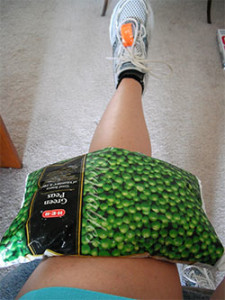
1. Ice your knee, 2 to 4 times per day, for 20-30 minutes each time. Do this for one week. Ice wraps are great, so are ziploc bags full of ice cubes. The old runner's trick is to buy a cheap bag of frozen peas and just use it over and over (but I don't recommend eating them later, yuck - so mark the bag with permanent ink just to be sure).

peas_knees

2. Take at least 48 hours off of running, walking fast, cycling, or other leg-intensive exercise. After two days, cycling might be your best bet as cross-training. You may need to take up to two weeks away from running (let pain be your guide here, if it hurts don't do it).

3. Go to your favorite natural vitamin store and buy some Bromelain in pill form. This is a natural substance from pineapple that helps to reduce inflammation. Take 2-4 of the pills per day for 1- 2 weeks, then re-evaluate based on pain. Please don't take the stuff year-round, of course, it's for treatment not maintenance.

4. Strengthen your quadriceps. Do the exercise shown at the very end of this Runner's World article .
You can also do simple leg lifts (just straighten your leg and hold it for a count of five, 10 times in a row, a few times per day) when seated at your chair at work. The key is to work your quadriceps - when they get stronger your knee cap will track in the appropriate plane and the pain should go away. This is the most-important thing you will need to do, so be diligent about it. You are a runner, diligence should be part of your middle name!

5. Runner's World also has a short video that demonstrates several exercises that can help runners prevent knee pain. Some of these may seem almost silly, but taken as a combined set they essentially create strength in several muscles which can then take some of the strain away from the knee area. Well worth a try.

Be patient, work those quads, and you will get back out there quickly. If you ignore the pain and refuse to stop running (try to "run through" this injury), I predict that it's going to set you back even longer in the near future. Yeah, I know you hate to hear that, but truth hurts sometimes. What's the old adage? An ounce of prevention is worth a pound of cure? That's similar to the case here: when runner's knee arises, quickly nip the injury in the bud or suffer with a very long layoff and possibly lots of appointments with doctors and physical therapists.

Good luck!

Monday, July 8, 2013

Product Review: Go ID


I just finished evaluating a new product: The Go ID Personal Emergency ID Kit. 

This is a small, make-at-home tag that you can attach to your sports watch, shoe, backpack, zipper pull, etc. so that vital information about you is readily available should you be involved in any kind of emergency situation. 

What I liked best about the Go ID:
  • It's REALLY EASY to set up. I'll be honest here, I was slightly worried about "getting it right", and about possibly messing up my "one shot" to align everything properly. My fears were totally unfounded. All you have to do is follow the online instructions, which walk you through the process easily. Not only did I get it right on my first try, I'm not sure I could have gotten it wrong without working hard to do so.
  • You don't have to remember it! Unlike other personal ID products that I've used over the years, once you've attached the Go ID to your sports watch, it's with you whenever you work out. You could also attach it to mobile phone, or key chain, or to anything else that you are most-likely to have with you when you leave the house. Very convenient.
  • The kit comes with extra supplies. This simple fact, so often ignored by many manufacturers, really makes a difference in my humble opinion. If I actually did mess up my first try, I'd have a couple more passes to nail it. And, should my Go ID suffer a bit of wear and tear over time, I can generate a new label. Nice. Finally: If you have a temporary health situation (e.g., post-op rehab, or maybe pregnancy), you can make a specific tag with that information - then change it later when the situation is different. Voila.
  • Comes in sizes - you can measure the size of your watch if that's where you want to put it, or you can order bigger/smaller simply on your own preferences.
  • A portion of the profits from the sale of Go ID will be shared with first-responder units. Those are brave people who are willing to risk their own lives to help all of us in any situation, they certainly deserve the recognition and support.
What I liked less about the Go ID:
  • It adds a little bit of bulk, if you are picky about such things. I use a Garmin Forerunner 110, which is already a slightly big wrist watch. Adding the Go ID underneath the watch (using small velcro-style stickers) did add to the feeling of bulk while running, but honestly I stopped noticing it after only a few minutes. And it's most certainly less of a factor than the water bottle I'm sometimes carrying on hot days. Note: I didn't even notice it when I was wearing it while cycling.
  • Attaching it to a shoe is a little complex for my tastes (unlacing, threading, re-lacing, etc.), but I'm not sure how to improve that one. I rotate my shoes every time I run, so I'd have to be dealing with this over and over again if I attached the tag to my shoe (which means I'll attach it to my watch instead). I suppose this is not an issue if you wear the same shoes all the time - but I strongly recommend against that in the first place, because if you are out there on run-after-run, mile-after-mile in the same pair of shoes, your risk of injury increases, period. But that's a topic for another post.
What I don't yet know about the Go ID:
  • Durability: I've only used it a few times and it shows no signs of wear, but I just don't know yet how it will fare over time. Jury is still out on this one.
  • Availability: Not sure these are distributed widely, you may not find it in a store in your area, but you can order it online right now.

Overall, I liked the product and would recommend it. We all live in a bubble of denial when it comes to accidents and emergencies, so it's easy to think you don't need any kind of identification when you slip out the door for your workout - I was guilty of this for many years myself. But I recommend that you make sure to provide a way for emergency personnel (or even assisting bystanders) to know quickly who you are, whom to contact on your behalf, and any health issues that should be taken into account. You might be the safest, least-accident-prone person in the world, but you can't control what some other bonehead might do that could result in you being hurt. Be safe out there!